
Nitimur in Vetitum: Meaning, Origins, and Later Use
Origin and Meaning
The idea that desire is relational rather than intrinsic has echoed across centuries of philosophical and psychological thought. One of its earliest and most enduring articulations appears in Ovid’s observation“We strive after what is forbidden, and always desire what is denied”, which is an approximate translation of Nitimur in vetitum, semper cupimusque negata (Ovid, Amores 3.4.17).
What begins as a playful poetic insight develops into a foundational principle within moral philosophy, where desire intensifies not because of inherent value, but because of prohibition itself. This dynamic later becomes central to Nietzsche’s conception of desire as a form of power and transgression, where restriction does not suppress instinct, but concentrates it.
Ovid’s Amores
The Constraint of Women and Forbidden Desire
In Amores 3.4, Ovid stages his insight through a scene of anxious authority between man and wife. The speaker addresses a husband who has been attempting to secure the fidelity of his wife through constant surveillance, by surrounding her with rules, attendants, and moral vigilance. Ovid amusingly treats this effort with irony.
The more closely the woman is watched, the more she is marked as forbidden; the more insistently she is protected, the more she becomes an object of curiosity and desire. What the husband understands as discipline, Ovid recasts as a provocation. He suggests that restriction does not extinguish longing but instead animates it. Desire, in this telling, is not born of freedom, but of constraint. This constraint is generated precisely at the point where control attempts to fix it in place.
Desire and Prohibition in Early Christianity
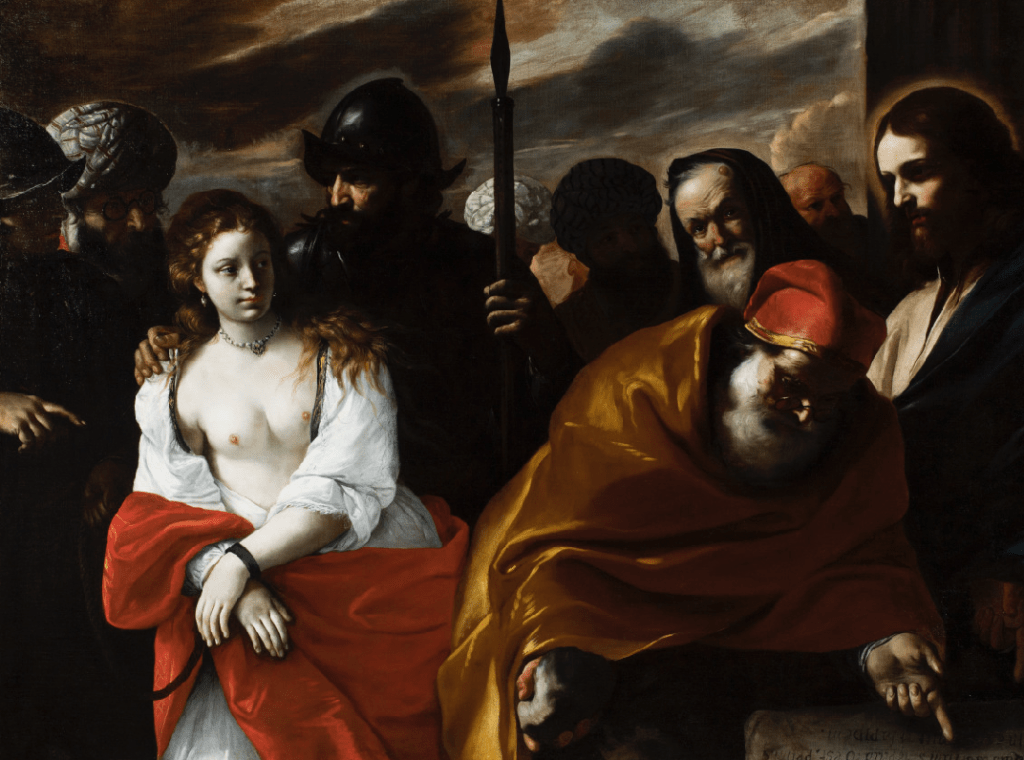
In early Christian texts, this logic of desire and prohibition is given juridical and theological form. Adultery, condemned under Mosaic law (Leviticus 20:10; Deuteronomy 22:22), becomes a visible marker of moral failure, subject not only to divine judgment but to communal enforcement. The Gospel of John recounts this dynamic in the episode of the woman taken in adultery (John 8:1–11), where religious authorities present a woman accused under the law and demand judgment according to its strictures. Her desire is isolated, named, and rendered public, then transformed into evidence through which this moral authority asserts itself. What Ovid exposes as a psychological paradox is here inherited as a moral economy where prohibition is preserved, intensified, and sanctified, and desire is displaced onto the figure of the transgressor.
Nietzsche’s “Nitimur in Vetitum”
For Friedrich Nietzsche, nitimur in vetitum becomes more than a psychological observation; it names a structural feature of moral life under repression. Across texts such as Beyond Good and Evil (1886), On the Genealogy of Morality (1887), and The Gay Science (1882), Nietzsche returns repeatedly to the idea that moral prohibition does not extinguish instinct but intensifies it, driving desire inward and transforming it into obsession, guilt, and resentment.
What is forbidden then acquires a kind of symbolic power precisely because it is denied, while moral systems that claim to suppress desire instead cultivate it in distorted forms. In this sense, Nietzsche radicalises Ovid’s insight. Prohibition does not merely provoke longing, it produces a psychology structured around transgression. Desire becomes a site of struggle, where instinct confronts moral law, and where power asserts itself not through expression but through restriction. Nitimur in vetitum, for Nietzsche, thus names the paradox at the heart of morality itself , where the systems built to regulate desire ultimately depend upon its repression for their authority.
References
Ovid. Amores. Book III, Elegy 4, line 17.
Latin text and English translation in:
Ovid. Amores. Translated by E. J. Showerman, revised by G. P. Goold. Loeb Classical Library 41. Cambridge, MA: Harvard University Press, 1914.
Available at: https://www.loebclassics.com/view/ovid-amores/1914/pb_LCL041.461.xml
The Holy Bible.
Leviticus 20:10; Deuteronomy 22:22.
New Testament: John 8:1–11 (The Woman Taken in Adultery)
Friedrich Nietzsche.
The Gay Science. 1882.
Beyond Good and Evil. 1886.
On the Genealogy of Morality. 1887.
Mattia Preti (1613–1699).
Christ and the Woman Taken in Adultery. 1640s. Oil on canvas, 143.8 × 191.8 cm.
European Art to 1800, Gallery 236.
Hendrik Goltzius (1558–1617).
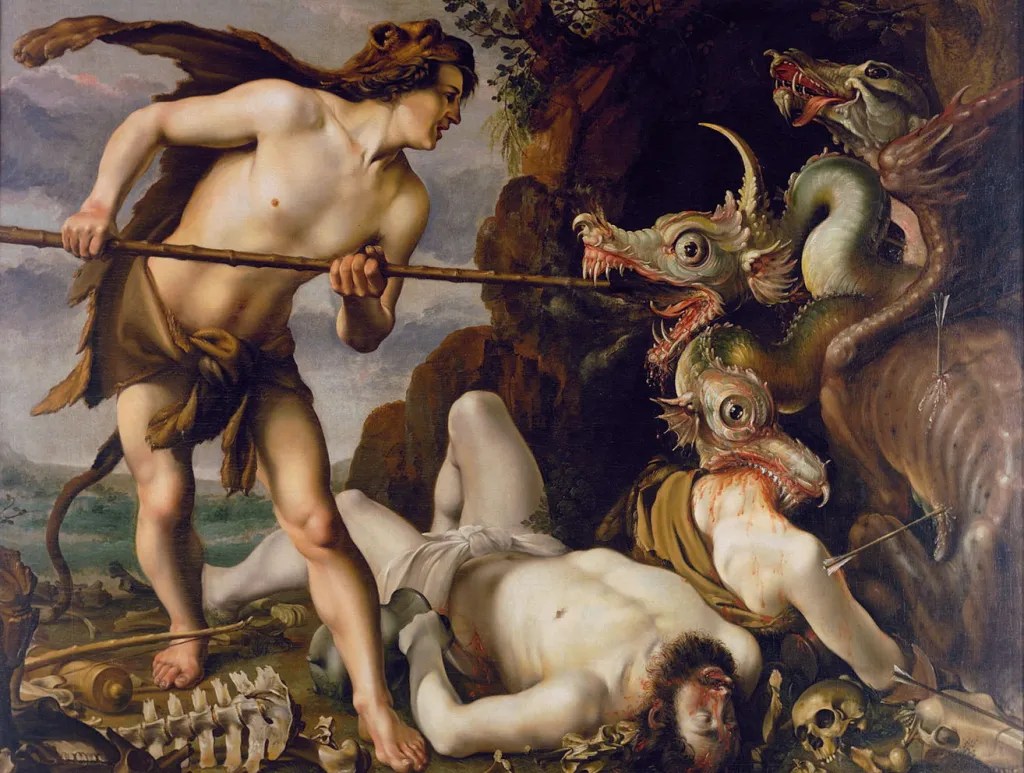
Cadmus Slays the Dragon. c. 1573–1617. Oil on canvas, 189 × 248 cm.
Museet på Koldinghus (Deposit of the Statens Kunstsamlinger), Copenhagen, Denmark.
 NIV London
Leave a comment